Ray Tune: grid search with ASHA early stopping
A Tuner sweeps the learning rate of a TorchTrainer over a grid, and the ASHA scheduler stops weak trials early.
When to use it. Hyperparameter sweeps where most configurations can be judged after a few iterations.
The picture below is the graph drawn in Eugo's visual Ray builder, and the cell under Generated code is the Ray code the builder produced from it. The code is plain Ray: it runs without the builder.
Back to the gallery · Tested with Ray 2.55.1
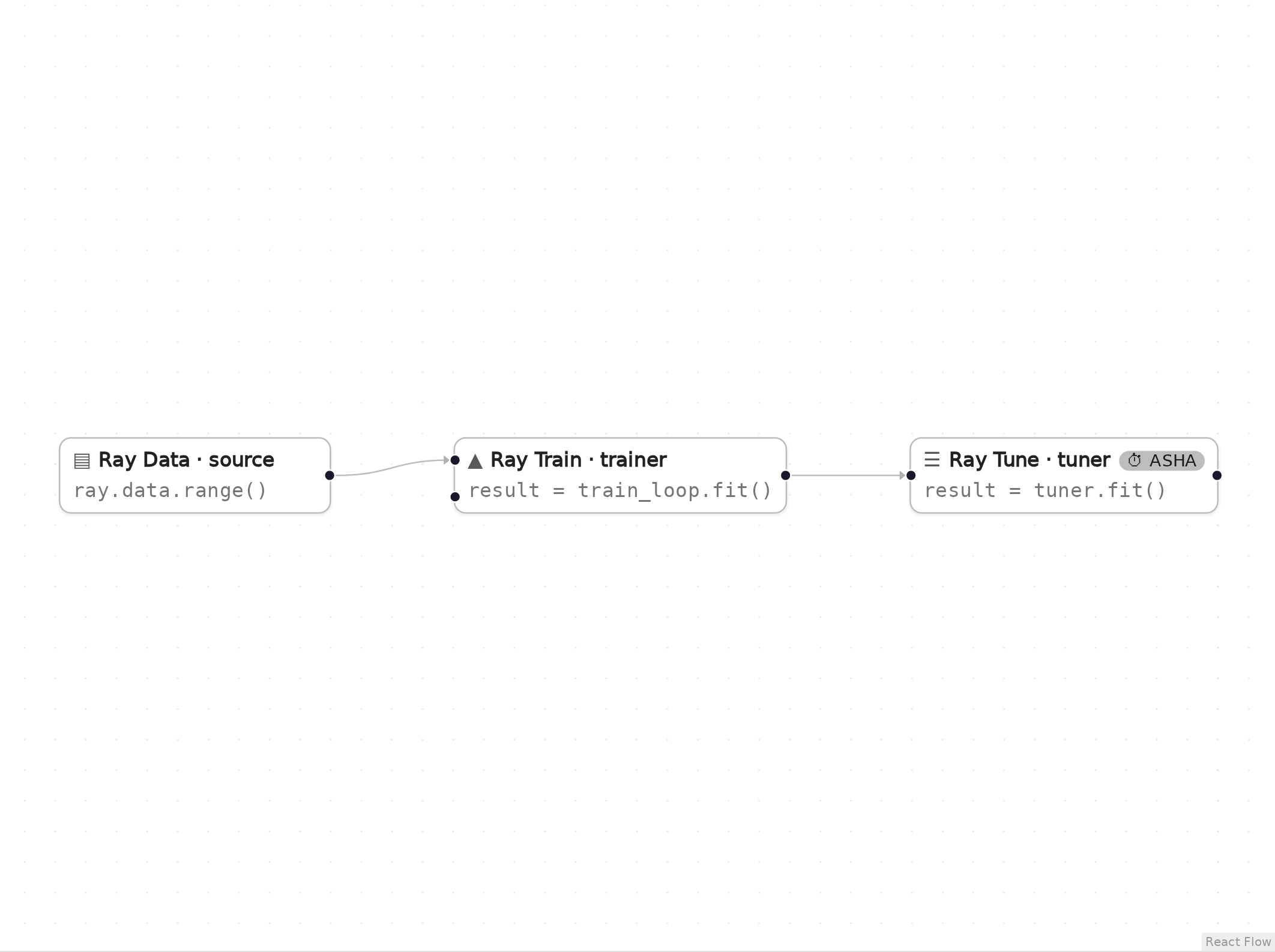
The graph in Eugo's visual Ray builder.
Setup
Start a local Ray instance. The options keep the notebook quiet: no dashboard, and worker logs stay out of the notebook. Ray is capped at four CPUs so the example behaves the same on any machine. The generated code below only calls ray.init() when Ray is not running yet, so it reuses this instance.
import ray
ray.init(include_dashboard=False, log_to_driver=False, logging_level="ERROR", num_cpus=4)
RayContext(dashboard_url='', python_version='3.12.3', ray_version='2.55.1', ray_commit='237c2455ebb1ea15a32dd9e1fdeb2d617badc37f')
User functions
The nodes in the graph call these ordinary Python functions and classes. In the builder you write them in a normal notebook cell, and the generated code refers to them by name.
import ray


def train_loop(config):
    # Runs once per trial; config["lr"] is the swept value.
    lr = config["lr"]
    shard = ray.train.get_dataset_shard("train")
    for _ in shard.iter_batches(batch_size=4):
        pass
    # Report several iterations so ASHA has rungs to compare.
    for i in range(5):
        ray.train.report({"loss": float(lr) / (i + 1)})
Generated code
This is the cell the visual builder generated from the graph above.
# Generated with Eugo's visual Ray builder

from ray import tune
import ray
from ray.train import RunConfig, ScalingConfig
from ray.train.torch import TorchTrainer
from ray.tune import TuneConfig, Tuner
from ray.tune.integration.ray_train import TuneReportCallback
from ray.tune.schedulers import ASHAScheduler

if not ray.is_initialized():
    ray.init()

ds = ray.data.range(8)

def _tune_driver_n3(config):
    trainer = TorchTrainer(train_loop, train_loop_config=config["train_loop_config"], scaling_config=ScalingConfig(num_workers=1, use_gpu=False), datasets={"train": ds}, run_config=RunConfig(callbacks=[TuneReportCallback()]))
    trainer.fit()

_tuner_n3 = Tuner(_tune_driver_n3, param_space={"train_loop_config": {"lr": tune.grid_search([0.01, 0.1])}}, tune_config=TuneConfig(num_samples=1, metric="loss", mode="min", max_concurrent_trials=1, scheduler=ASHAScheduler(grace_period=1, max_t=5, reduction_factor=2)))
result = _tuner_n3.fit()
best = result.get_best_result()
Check the result
The cell below checks that the generated code did what the graph describes: the sweep picks lr=0.01, the lr=0.01 trial runs all max_t=5 iterations, and ASHA stops the lr=0.1 trial before that. The outcome is the same on every run. The toy loss lr / (i + 1) is lower for the smaller learning rate at every iteration, and with max_concurrent_trials=1 the grid runs in order, so the lr=0.01 trial finishes first and sets the bar at each of ASHA's rungs (iterations 1, 2 and 4). The lr=0.1 trial reports a worse loss at the first rung, and ASHA stops it there.
assert len(result) == 2, len(result)
assert all(r.error is None for r in result), [r.error for r in result]
best_lr = best.config["train_loop_config"]["lr"]
assert best_lr == 0.01, best_lr  # the toy loss lr / (i + 1) is lower for the smaller lr

max_t = 5  # ASHAScheduler(max_t=5) in the generated code
iterations = {r.config["train_loop_config"]["lr"]: r.metrics["training_iteration"] for r in result}
assert iterations[0.01] == max_t, iterations  # the better trial ran to the end
assert iterations[0.1] < max_t, iterations  # ASHA stopped the worse trial early
print("best lr =", best_lr)
print("iterations run per lr:", iterations)
best lr = 0.01
iterations run per lr: {0.01: 5, 0.1: 1}
How the graph maps to the code
Each step names a node in the picture by its label, the lines of the generated cell it produced, and what those lines do. Node ids such as n1 are not drawn on the canvas. Where the builder names a variable after a node, the id is its suffix (for example _tuner_n3).
Setup (lines 1, 3–9 and 11–12)
# Generated with Eugo's visual Ray builder
...
from ray import tune
import ray
from ray.train import RunConfig, ScalingConfig
from ray.train.torch import TorchTrainer
from ray.tune import TuneConfig, Tuner
from ray.tune.integration.ray_train import TuneReportCallback
from ray.tune.schedulers import ASHAScheduler
...
if not ray.is_initialized():
    ray.init()
The first line marks the cell as generated. The builder then adds an import for every Ray API the graph uses and a guarded ray.init(), so re-running the cell reuses the running cluster.
Source (node n1, line 14)
ds = ray.data.range(8)
The dataset every trial trains on.
Tuner (node n3, lines 16, 18 and 20–22)
def _tune_driver_n3(config):
...
    trainer.fit()
...
_tuner_n3 = Tuner(_tune_driver_n3, param_space={"train_loop_config": {"lr": tune.grid_search([0.01, 0.1])}}, tune_config=TuneConfig(num_samples=1, metric="loss", mode="min", max_concurrent_trials=1, scheduler=ASHAScheduler(grace_period=1, max_t=5, reduction_factor=2)))
result = _tuner_n3.fit()
best = result.get_best_result()
Tuner(..., param_space=grid_search over lr, tune_config=TuneConfig(metric="loss", mode="min", scheduler=ASHAScheduler(...))) runs the trials; get_best_result() picks the lowest loss.
Trainer (node n2, line 17)
trainer = TorchTrainer(train_loop, train_loop_config=config["train_loop_config"], scaling_config=ScalingConfig(num_workers=1, use_gpu=False), datasets={"train": ds}, run_config=RunConfig(callbacks=[TuneReportCallback()]))
The trainer is moved inside a per-trial driver function, so each trial runs its own TorchTrainer with that trial's train_loop_config.
Clean up
Shut down Ray, so the next notebook starts fresh.
ray.shutdown()