Take the first results with ray.wait
Three tasks with different run times feed a Wait node. ray.wait returns as soon as two are done, leaving the slow one running.
When to use it. Racing replicas, processing results as they complete, or enforcing a deadline on a batch of tasks.
The picture below is the graph drawn in Eugo's visual Ray builder, and the cell under Generated code is the Ray code the builder produced from it, edited by hand so that each function is wrapped with ray.remote once (the cell's first line says so). The code is plain Ray: it runs without the builder.
Back to the gallery · Tested with Ray 2.55.1
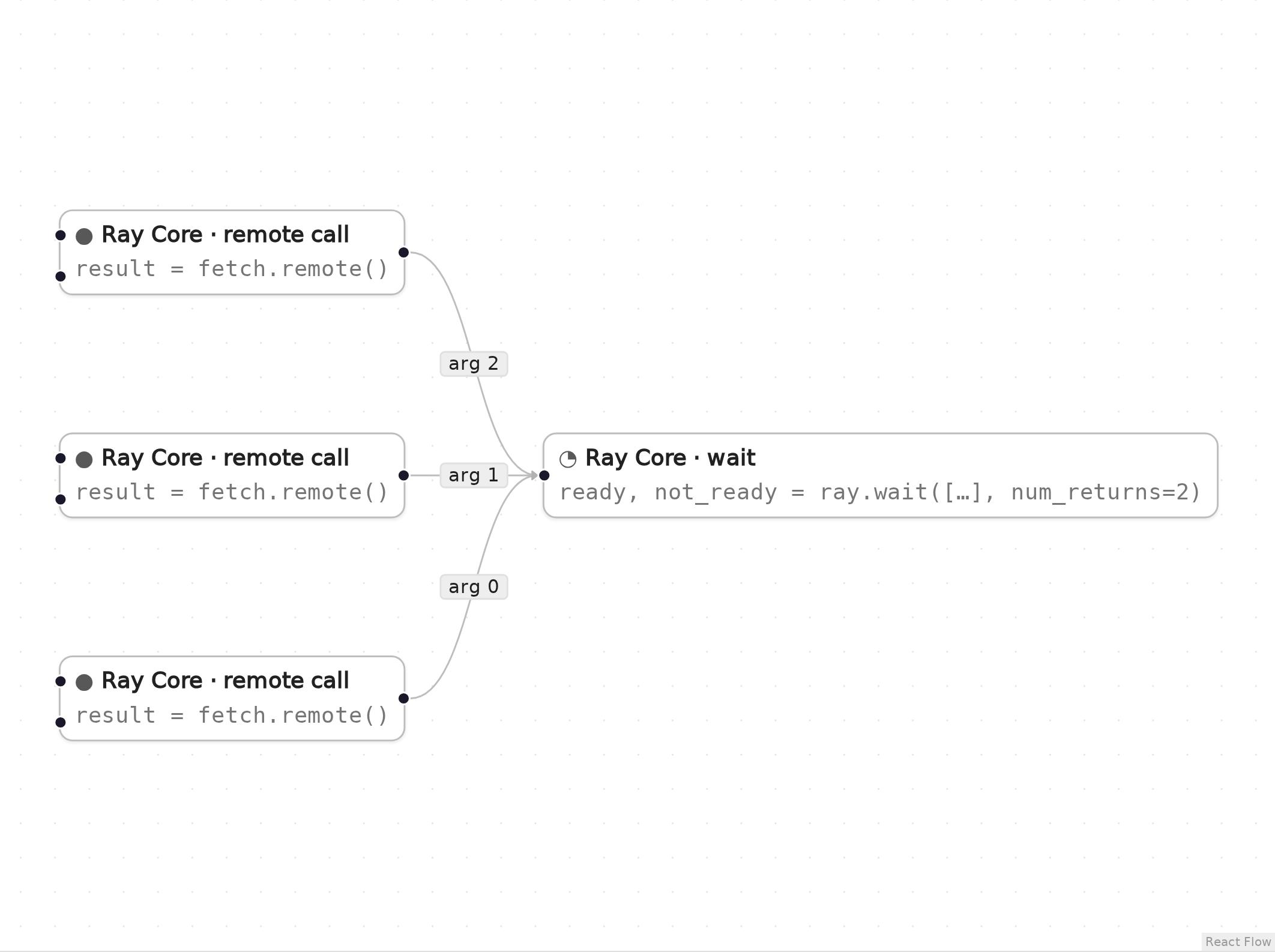
The graph in Eugo's visual Ray builder. All three tasks show fetch.remote(). From top to bottom they are fetch(0.2) (arg 2), the slow fetch(5.0) (arg 1) and fetch(0.1) (arg 0).
Setup
Start a local Ray instance. The options keep the notebook quiet: no dashboard, and worker logs stay out of the notebook. Ray is capped at four CPUs so the example behaves the same on any machine. The generated code below only calls ray.init() when Ray is not running yet, so it reuses this instance.
import ray
ray.init(include_dashboard=False, log_to_driver=False, logging_level="ERROR", num_cpus=4)
RayContext(dashboard_url='', python_version='3.12.3', ray_version='2.55.1', ray_commit='237c2455ebb1ea15a32dd9e1fdeb2d617badc37f')
User functions
The nodes in the graph call these ordinary Python functions and classes. In the builder you write them in a normal notebook cell, and the generated code refers to them by name.
import time


def fetch(delay):
    time.sleep(delay)
    return delay
Generated code
This is the cell the visual builder generated from the graph above, with one edit by hand. The builder wrote ray.remote(fetch) at each of the three task calls, and every ray.remote(...) call makes a new remote function that Ray exports to the cluster again; Ray's documentation lists this as an anti-pattern (Redefining the same remote function or class harms performance). The cell below wraps fetch once and reuses it.
# Generated with Eugo's visual Ray builder, then edited by hand: each function is wrapped with ray.remote once

import ray

if not ray.is_initialized():
    ray.init()

fetch_task = ray.remote(fetch)

_n1 = fetch_task.remote(0.1)
_n2 = fetch_task.remote(5.0)
_n3 = fetch_task.remote(0.2)
ready_w1, not_ready_w1 = ray.wait([_n1, _n2, _n3], num_returns=2, timeout=30)
first_two = ray.get(ready_w1)
Check the result
The cell below checks that the generated code did what the graph describes.
assert sorted(first_two) == [0.1, 0.2], first_two
assert len(not_ready_w1) == 1
print("first two finished:", sorted(first_two))
first two finished: [0.1, 0.2]
How the graph maps to the code
Each step names a node in the picture, the lines of the generated cell it produced, and what those lines do. The node id (for example n1) is also the suffix of the variable that holds the node's result.
Setup (lines 1, 3 and 5–6)
# Generated with Eugo's visual Ray builder, then edited by hand: each function is wrapped with ray.remote once
...
import ray
...
if not ray.is_initialized():
    ray.init()
The first line marks the cell as generated and names the edit made by hand. The builder then adds an import for every Ray API the graph uses and a guarded ray.init(), so re-running the cell reuses the running cluster.
Remote function (line 8, edited by hand)
fetch_task = ray.remote(fetch)
ray.remote turns the plain function into a remote function, once; the three task nodes below call .remote() on it.
Remote task (node n1, line 10)
_n1 = fetch_task.remote(0.1)
A fast task (0.1 s).
Remote task (node n2, line 11)
_n2 = fetch_task.remote(5.0)
A slow task (5 s). It is still running when ray.wait returns.
Remote task (node n3, line 12)
_n3 = fetch_task.remote(0.2)
Another fast task (0.2 s).
Wait (node w1, lines 13–14)
ready_w1, not_ready_w1 = ray.wait([_n1, _n2, _n3], num_returns=2, timeout=30)
first_two = ray.get(ready_w1)
ray.wait splits the refs into ready and not-ready lists once num_returns=2 are done (or after the 30 s timeout); ray.get then fetches only the ready ones.
Clean up
Shut down Ray, so the next notebook starts fresh.
ray.shutdown()