Ray Data: batch inference with an actor pool
map_batches with a callable class and ActorPoolStrategy: each actor runs the expensive setup once and then processes many batches.
When to use it. Batch inference or any transform with costly setup, such as loading a model or opening a connection.
The picture below is the graph drawn in Eugo's visual Ray builder, and the cell under Generated code is the Ray code the builder produced from it. The code is plain Ray: it runs without the builder.
Back to the gallery · Tested with Ray 2.55.1
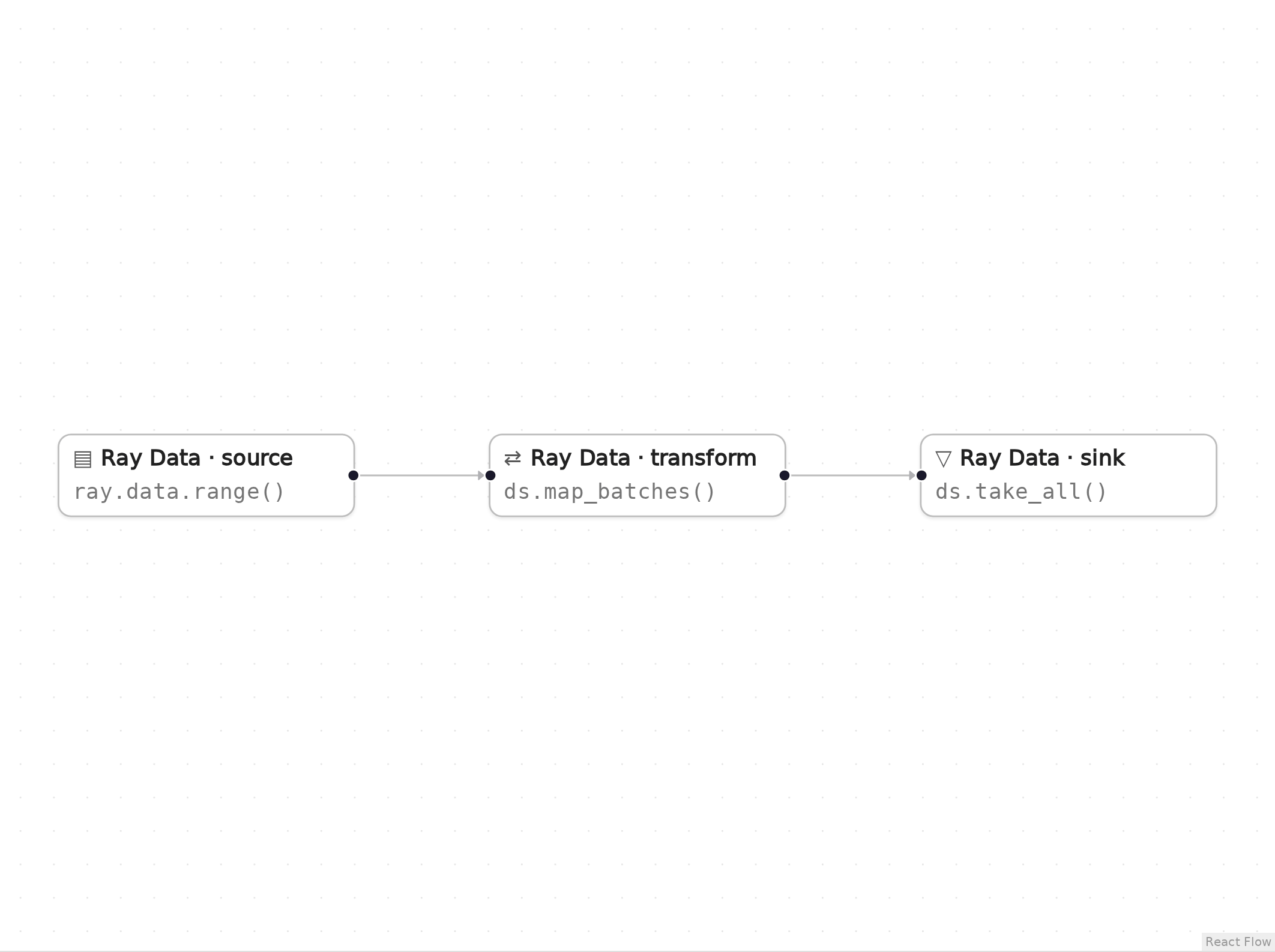
The graph in Eugo's visual Ray builder.
Setup
Start a local Ray instance. The options keep the notebook quiet: no dashboard, and worker logs stay out of the notebook. Ray is capped at four CPUs so the example behaves the same on any machine. The generated code below only calls ray.init() when Ray is not running yet, so it reuses this instance.
import ray
ray.init(include_dashboard=False, log_to_driver=False, logging_level="ERROR", num_cpus=4)
RayContext(dashboard_url='', python_version='3.12.3', ray_version='2.55.1', ray_commit='237c2455ebb1ea15a32dd9e1fdeb2d617badc37f')
User functions
The nodes in the graph call these ordinary Python functions and classes. In the builder you write them in a normal notebook cell, and the generated code refers to them by name.
class AddOffset:
    def __init__(self, offset):
        # Expensive setup (for example, loading a model) runs once per actor.
        self.offset = offset

    def __call__(self, batch):
        batch["id"] = batch["id"] + self.offset
        return batch
Generated code
This is the cell the visual builder generated from the graph above.
# Generated with Eugo's visual Ray builder

import ray
from ray.data import ActorPoolStrategy

if not ray.is_initialized():
    ray.init()

ds = ray.data.range(20)
ds = ds.map_batches(AddOffset, batch_size=5, compute=ActorPoolStrategy(size=2), fn_constructor_args=(100,))
rows = ds.take_all()
Check the result
The cell below checks that the generated code did what the graph describes.
ids = sorted(r["id"] for r in rows)
assert ids == list(range(100, 120)), ids
print("ids =", ids)
ids = [100, 101, 102, 103, 104, 105, 106, 107, 108, 109, 110, 111, 112, 113, 114, 115, 116, 117, 118, 119]
How the graph maps to the code
Each step names a node in the picture, the lines of the generated cell it produced, and what those lines do. The node id (for example n1) is also the suffix of the variable that holds the node's result.
Setup (lines 1, 3–4 and 6–7)
# Generated with Eugo's visual Ray builder
...
import ray
from ray.data import ActorPoolStrategy
...
if not ray.is_initialized():
    ray.init()
The first line marks the cell as generated. The builder then adds an import for every Ray API the graph uses and a guarded ray.init(), so re-running the cell reuses the running cluster.
Source (node n1, line 9)
ds = ray.data.range(20)
Twenty input rows.
Transform (node n2, line 10)
ds = ds.map_batches(AddOffset, batch_size=5, compute=ActorPoolStrategy(size=2), fn_constructor_args=(100,))
compute=ActorPoolStrategy(size=2) runs AddOffset in two long-lived actors; fn_constructor_args=(100,) goes to init, and batch_size=5 sets the rows per call.
Sink (node n3, line 11)
rows = ds.take_all()
take_all() collects the transformed rows.
Clean up
Shut down Ray, so the next notebook starts fresh.
ray.shutdown()