Named actor: create, look up, call and kill
A detached actor is registered under a name, looked up again with ray.get_actor, called, and finally removed with ray.kill.
When to use it. Services shared across jobs or notebooks (a model cache, a coordinator) that other code finds by name.
The picture below is the graph drawn in Eugo's visual Ray builder, and the cell under Generated code is the Ray code the builder produced from it. The code is plain Ray: it runs without the builder.
Back to the gallery · Tested with Ray 2.55.1
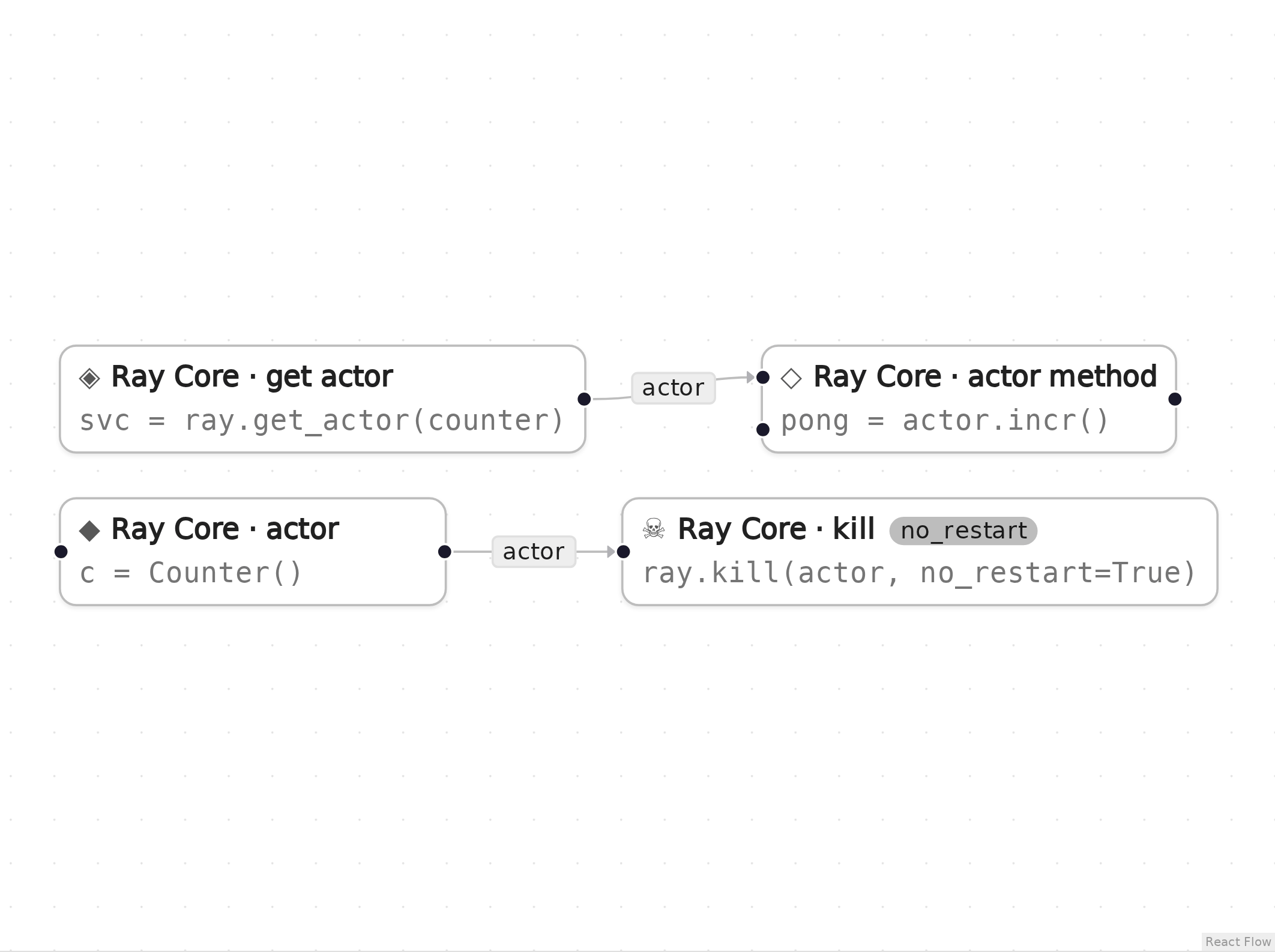
The graph in Eugo's visual Ray builder.
Setup
Start a local Ray instance. The options keep the notebook quiet: no dashboard, and worker logs stay out of the notebook. Ray is capped at four CPUs so the example behaves the same on any machine. The generated code below only calls ray.init() when Ray is not running yet, so it reuses this instance.
import ray
ray.init(include_dashboard=False, log_to_driver=False, logging_level="ERROR", num_cpus=4)
RayContext(dashboard_url='', python_version='3.12.3', ray_version='2.55.1', ray_commit='237c2455ebb1ea15a32dd9e1fdeb2d617badc37f')
User functions
The nodes in the graph call these ordinary Python functions and classes. In the builder you write them in a normal notebook cell, and the generated code refers to them by name.
class Counter:
    def __init__(self):
        self.n = 0

    def incr(self):
        self.n += 1
        return self.n
Generated code
This is the cell the visual builder generated from the graph above.
# Generated with Eugo's visual Ray builder

import ray

if not ray.is_initialized():
    ray.init()

c = ray.remote(Counter).options(name="counter", lifetime="detached", get_if_exists=True).remote()
svc = ray.get_actor("counter")
_m1 = svc.incr.remote()
pong = ray.get(_m1)
ray.kill(c, no_restart=True)
Check the result
The cell below checks that the generated code did what the graph describes.
import time

assert pong == 1, pong
for _ in range(100):
    try:
        ray.get_actor("counter")
    except ValueError:
        break
    time.sleep(0.1)
else:
    raise AssertionError("the actor is still registered after ray.kill")
print("pong =", pong, "; actor removed")
pong = 1 ; actor removed
How the graph maps to the code
Each step names a node in the picture, the lines of the generated cell it produced, and what those lines do. The node id (for example n1) is also the suffix of the variable that holds the node's result.
Setup (lines 1, 3 and 5–6)
# Generated with Eugo's visual Ray builder
...
import ray
...
if not ray.is_initialized():
    ray.init()
The first line marks the cell as generated. The builder then adds an import for every Ray API the graph uses and a guarded ray.init(), so re-running the cell reuses the running cluster.
Actor (node a1, line 8)
c = ray.remote(Counter).options(name="counter", lifetime="detached", get_if_exists=True).remote()
name="counter" registers the actor, lifetime="detached" keeps it alive after the driver exits, and get_if_exists=True reuses an existing one instead of failing.
Get actor (node g1, line 9)
svc = ray.get_actor("counter")
ray.get_actor finds the actor by name, the way another job or notebook would.
Actor method (node m1, lines 10–11)
_m1 = svc.incr.remote()
pong = ray.get(_m1)
Calls incr through the looked-up handle.
Kill actor (node k1, line 12)
ray.kill(c, no_restart=True)
ray.kill removes the detached actor; no_restart=True stops Ray from restarting it.
Clean up
Shut down Ray, so the next notebook starts fresh.
ray.shutdown()